
Spatial Planning: How Room Flow and Layout Shape Daily Living
Spatial Planning 101: How Room Layout and Flow Shape the Way You Live
Most people don't think about spatial planning until something goes wrong. The kitchen that turns into a traffic jam every morning. The living room that never feels quite right no matter how many times you rearrange the furniture. The hallway that somehow makes the whole house feel smaller than it is. These aren't decorating problems — they're layout problems. And they affect how you feel in your home every single day, even when you can't name exactly what's causing the frustration.
Spatial planning is the work of getting those fundamentals right — organizing your rooms, your traffic paths, and your living zones so that your home supports the way you actually live, not the way someone assumed you would when it was built.
Get spatial planning right, and your home feels easy. Movement is natural. Rooms feel calm and purposeful. Get it wrong, and no amount of beautiful tile or carefully chosen furniture will fix the fact that your kitchen bottlenecks every morning or your living room never quite feels settled. Whether you're thinking about a whole home remodel, a bathroom update, or something in between, it all starts with understanding how your home flows.
Wendy Langston, founder and CEO of Everything Home Designs in Carmel, Indiana, has spent more than 25 years helping families figure out exactly why their homes feel off — and what to do about it. She's learned that most people already know when their home doesn't flow. They feel it in the morning rush, in the hallway that forces everyone into each other, in the room that should feel relaxing but never quite does. What they don't always know is why.
"Layout is the foundation underneath everything else in a home," Wendy says. "Get it right and every other design decision is easier. Get it wrong and no amount of beautiful finishes or thoughtful furniture can fully compensate for a space that works against the people living in it."
What Spatial Planning Actually Means
Spatial planning is the process of organizing your home so it works for the people living in it. It covers everything from how big your rooms are to how wide your hallways are, where your kitchen island sits, and whether your furniture is the right size for the space around it.
But Wendy thinks about spatial planning in a deeper way than most. Her background in yoga and Ayurveda has shaped how she reads a space — and it goes well beyond measurements and furniture placement.
"A room isn't just something you look at. It's something you move through, breathe in, and feel. When I walk into a room, I'm not only reading it visually. I'm reading how it feels to be in the body there. Is there an intuitive path through the space, or does your body have to solve a small puzzle every time you cross it?"
Ayurveda — the ancient wellness system Wendy draws from — holds that your environment is never neutral. It either supports your wellbeing or quietly works against it. Once you understand that, she says, you can't unsee it in home design.
"A well-designed room should feel like a deep breath. Not because it looks a certain way — but because nothing in it is asking your body to brace."
That's what good spatial planning delivers. And it's where every great remodel begins.
How People Move Through a Home
The foundation of any spatial planning conversation is circulation — the paths people naturally take as they move from room to room. These fall into three basic categories.
Primary pathways are the ones used every single day: kitchen to dining room, front door to living room, bedroom to bathroom. These need to be clear, wide enough for two people at once, and free of obstacles. Secondary pathways are used regularly but less often — bedroom to laundry room, home office to kitchen. These should be convenient without cutting through busy areas. Tertiary pathways cover occasional access: storage areas, guest rooms, utility spaces. These can be tucked away without disrupting daily flow.
A widely used benchmark in residential design is the 36-inch clearance rule — walkways should provide at least 36 inches of comfortable passage. In high-traffic areas like kitchens, this is critical.
Wendy sees the impact of poor circulation constantly in her work. "A kitchen island that's great for function might create awkward traffic flow when you add barstools. Those are the decisions that affect how a space actually feels to be in, and they have to be considered before anything is built."
The Daily Rhythm Your Layout Should Support
Good spatial planning isn't designed for a theoretical family. It's designed for the one that actually lives in the home.
When Wendy works with Carmel families, she pays close attention to how their days actually run — because the rhythm of a real family's life should directly shape layout decisions.
Mornings are compressed and high-traffic. Multiple people move through the same spaces at the same time, often carrying school bags, sports equipment, and coffee. The kitchen and mudroom are both at capacity simultaneously. If those two spaces aren't well connected — if the path between them doesn't have real flow — that morning friction compounds every single day.
Afternoons bring the after-school drop zone moment: bags, snacks, devices. If the layout doesn't have a clear place for that transition to happen, it happens on the kitchen counter or the dining room table, which then has to be cleared for dinner. That friction loop runs five days a week.
Evenings in most Central Indiana households are gathered. Dinner is a real event. The kitchen is active, the dining space is in use, the family is together. Layouts that separate cooking from the rest of the family during that time work against the actual culture of the household.
"When we understand that rhythm, we can design for it," Wendy says. "Not for a theoretical family — but for the one that actually lives there."
Why Carmel Homes Have Specific Spatial Planning Challenges
After working across Carmel and the surrounding area for decades, Wendy has come to expect certain layout patterns — and they're not random. They're byproducts of when and how homes were built.
In older neighborhoods near the Arts & Design District and the historic core, the most common issue is compartmentalization. These homes were built when rooms were rooms — the kitchen was for cooking, the dining room was for dining, the living room was formal. That worked for a different era. It doesn't work for how modern families live, which tends to be more fluid and more gathered.
"We're frequently asked to open these homes up — to remove the wall between the kitchen and dining room, to create sightlines from the cooking space to where kids are doing homework. The bones of these homes are often beautiful and the character is irreplaceable. But the layout has to be updated for the life being lived in it now."
In newer Carmel and Zionsville builds — Holliday Farms, The Villages of West Clay, and newer construction throughout Hamilton County — the spatial planning challenge runs the other direction. Open floor plans designed to feel spacious can end up feeling chaotic because there's no definition to how the space is organized. When the kitchen, dining area, living room, and entry all blend into one undifferentiated space, the home can feel impossible to settle into.
"Both problems are fundamentally flow problems," Wendy explains. "One creates friction through too many barriers. The other creates drift through too few. The solution in both cases is designing with intentionality — creating clear paths, defined zones, and transitions that tell your body where it is and what it's there to do."
Scale, Proportion, and Spatial Planning
Spatial planning isn't only about pathways and square footage. It's also about how every element within a space relates to everything around it — which is where scale and proportion become central.
Wendy says the most common spatial planning mistake she encounters isn't structural. It's furniture. "The number one thing I see is furniture oversized or undersized and placed around the perimeter. A sofa pushed against a wall in a room that's big enough to float it properly, or a dining table that's too small for the space around it — it creates this disconnected feeling that people sense even if they can't quite name it."
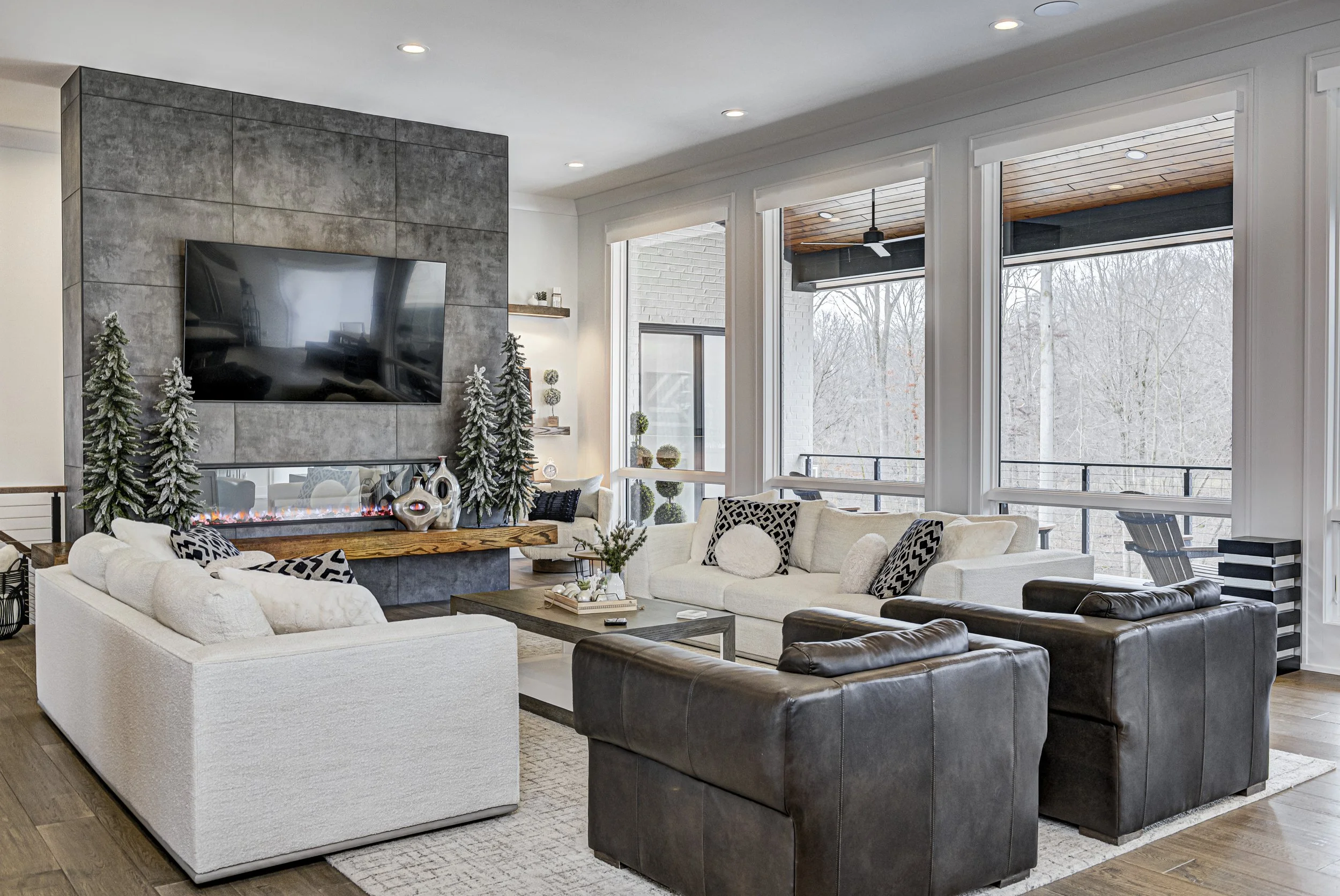
Rugs are one of the clearest examples of how scale affects spatial planning. A rug that's too small doesn't just look off — it undermines the entire spatial logic of the room. Wendy's rule: in a living room, at least the front legs of your sofa and chairs should rest on the rug. In a dining room, the rug should extend 24 to 30 inches past the table on every side.
She describes a client in a newer Carmel home who couldn't figure out why her great room felt off despite beautiful furniture and good natural light. "When I walked in, I could see it immediately: the rug. It was a 5x8 sitting under a full sectional, and it looked like a postage stamp." They swapped it for a 10x14. "The seating area suddenly had an identity — it felt intentional, contained, like a real living space instead of furniture just placed in a room. She texted me that night and said it felt like she'd gotten a new house."
The Smallest Change That Made the Biggest Difference
Sometimes spatial planning isn't about moving walls. Sometimes it's about a door swing.
Wendy worked with a family in a newer Carmel home whose main living area always felt chaotic — even when it was clean. Good furniture scale, functional storage, nice finishes. But the space never settled.
"When we did a walkthrough specifically looking for flow, we found it almost immediately: the door from the garage entry swung directly into the kitchen. When it was open — which it was constantly, because the garage was the primary entry point for the whole family — it bisected the kitchen workspace and blocked the sightline to the living room. Every time someone came home, the room was literally interrupted."
They rehung the door to swing in the opposite direction. The change took about three hours. The effect was immediate.
"The kitchen felt twice as open, the path from entry to living space was clear, and the visual connection between the kitchen and the family room that had always been intended by the layout finally actually existed. The family told us it changed how the whole house felt."
That's what flow work really is. You're not always moving walls. Sometimes you're just removing the thing that was quietly working against you every single day.
How 3D Spatial Planning Helps You See It Before It's Built
Understanding a floor plan and understanding how a space will feel to live in are two completely different things.
Floor plans are essential but abstract. Most people can't tell from a two-dimensional drawing whether a hallway will feel cramped or whether a kitchen island will block an important sightline. That's where 3D renderings do their most important work — not to make a project look beautiful before it's built, but to let clients actually feel the spatial planning before committing to it.
Wendy describes a client redesigning the main living level of their Carmel home. On paper, the plan looked right. But when she walked them through the 3D rendering, they noticed the kitchen island was going to partially obstruct the sightline from the kitchen to the fireplace.
"We shifted the island rotation by about 15 degrees and moved it 12 inches closer to the range. In the floor plan, it was a minor adjustment. In the rendering, it opened the sightline completely and changed the entire feel of how the two spaces connected. The client signed off with real confidence — not because they trusted the plan, but because they had actually seen the space."
Evaluating the Spatial Planning in Your Own Home
You don't need a design background to start noticing spatial planning issues where you live. Just pay attention to where your daily routine creates friction.
The single most useful exercise Wendy recommends is to walk through your morning from alarm to out the door — and notice every moment that feels awkward, crowded, or inefficient. You might find that two people share one bathroom mirror at the same time every day. That the coffee maker is three steps from where everyone eats breakfast. That backpacks end up on the floor in the hallway every single day because there's simply nowhere logical for them to go.
She also asks clients: is there a room you avoid? "People always have one. A formal living room that no one enters. A dining room that's become a drop zone for mail and packages. A primary bedroom that should feel like a retreat but never does. That question usually leads directly to a layout or flow issue."
And finally: if you could change one thing about how your home feels on a hard day — not how it looks, but how it feels — what would it be? "That question gets past the aesthetic wish list and into the lived experience. Clients tell us things like 'I just want to come home and feel like I can exhale.' That's a design brief. That tells us everything about what the spatial planning needs to do."
Spatial Planning Is Where Every Great Remodel Begins
Whether you're planning a kitchen remodel, finishing a basement, or considering a whole home renovation, spatial planning should be the first conversation — not an afterthought once materials are selected.
The homes that feel genuinely good to live in aren't the ones with the most expensive finishes. They're the ones where movement is natural, rooms feel purposeful, and every element has been considered in relationship to everything around it.
"Your home should feel like it was designed for you," Wendy says. "Because it was."
Ready to see what a difference spatial planning can make in your home? The team at Everything Home Designs has helped families across Carmel and Central Indiana create spaces that feel as good as they look. Whether you're starting a full remodel or just trying to figure out why a room isn't working, Wendy and her team are happy to help. Schedule a free consultation with our design team today.