
Top 5 Bathroom Remodeling Mistakes to Avoid
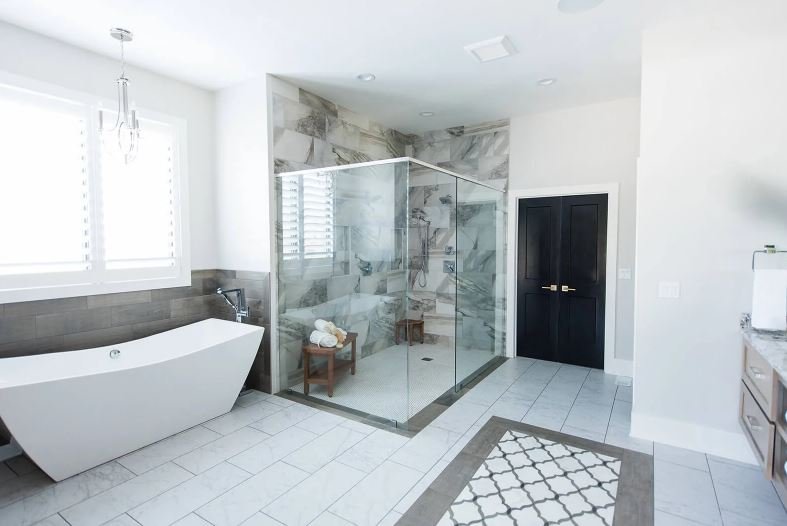
Most bathroom remodels don't go wrong all at once. They go wrong slowly — one avoidable decision at a time — until a project that was supposed to transform a space ends up costing far more than it should have, taking far longer than anyone expected, or both.
Wendy Langston has been leading bathroom remodels across Carmel, Zionsville, Fishers, and Westfield for more than 25 years. In that time, she's walked into hundreds of homes — some at the start of a project, and some after another firm left things in a difficult place. The mistakes she sees most often aren't random. They're predictable. And they're almost entirely avoidable.
Here are the top five bathroom remodeling mistakes Wendy sees — and what you should do instead.
Bathroom Remodel Mistake #1: Hiring the Wrong Firm
This is the mistake that pains Wendy most — not because it's the most dramatic, but because it's the most expensive and the most preventable.
"It's not necessarily a bad firm. It's a firm that simply wasn't equipped to work at the level the project required — and took it anyway."
A couple came to Everything Home Designs from a home in Zionsville. They had hired a general remodeling contractor the year before, largely based on price. The quote was $38,000. It felt like a deal on a project they knew should probably cost more — but the number was compelling, and the contractor was confident.
What followed was seven months of broken promises. Materials were ordered incorrectly and reordered late. The shower waterproofing was installed incorrectly — something they didn't discover until grout began darkening and moisture started appearing at the baseboard of the adjacent bedroom wall. The vanity turned out to be a standard cabinet with an applied face, not the custom piece they thought they were getting. The contractor eventually abandoned the project mid-finish.
When Wendy's team walked the space, the assessment was sobering. The shower had to be fully demolished — every surface, every membrane, back to the studs. The subfloor had absorbed two years of moisture damage. The total cost to correct and complete the project properly exceeded $140,000.
"The original $38,000 wasn't a savings. It was a down payment on a much larger problem. The most expensive bathroom remodel you can do is the one you have to do twice," says Wendy.
This is also one of the biggest reasons bathroom remodel costs vary so dramatically from one project to the next — and why understanding what's actually included in a quote matters as much as the number itself. If you haven't read it already, our post on how much a bathroom remodel really costs breaks down what drives pricing and what to watch for when comparing quotes.
What to do instead: Vet bathroom contractors carefully before signing anything. Understand exactly how they handle material selections, procurement, and pricing. Ask whether they use allowances — and if they do, understand what that means for your final cost. A firm that can't give you a firm final price before construction begins is a firm that hasn't done the pre-construction work your project requires.
Bathroom Remodel Mistake #2: Treating Planning as Something You Can Do as You Go
Poor planning in a bathroom remodel rarely looks like a bad decision. In fact, it often looks like a perfectly reasonable one. It looks like a homeowner who says "we'll finalize the tile once we see the space" or "we'll decide on the fixtures once we get further along" — and genuinely believes that's a flexible, sensible approach.
It isn't. And understanding why requires understanding how a remodel actually sequences.
Every decision in a bathroom remodel has dependencies. The plumber needs the exact rough-in dimension of a freestanding tub filler before setting the floor flange — and that dimension varies by manufacturer, sometimes by inches. The electrician needs to know whether the vanity has an integrated lighting system or a separate wall fixture before determining outlet placement. The tile setter needs to know the exact format and thickness of every surface material before calculating substrate build-out. The glass company can't measure for a frameless enclosure until tile is set — but the enclosure design affects how tile is laid at the threshold.
By the time each trade arrives on site, the window for making the decision they need has already closed.
Here's what poor bathroom renovation planning specifically looks like in practice:
Choosing a bathroom layout before understanding what the plumbing will support. Moving a toilet or relocating a shower drain isn't cosmetic — it's a significant rough-in change that affects the structural floor and the budget. Homeowners who commit to a layout without understanding their existing conditions often discover mid-demo that the design they love costs $15,000 more than the one they budgeted for.
Selecting bathroom finishes without a design framework. Tile chosen in isolation from stone. Hardware selected before the vanity finish is decided. Individual pieces that each look beautiful but don't cohere — and a finished room that feels assembled rather than designed.
Treating lighting as an afterthought. Lighting in a primary bath is not a fixture purchase. It's a design system — ambient, task, accent — that requires its own electrical planning and its own relationship to the material surfaces it illuminates. Decisions about lighting made after walls are closed require reopening them.
Assuming permits are someone else's problem. In Carmel, Zionsville, Fishers, and Westfield, and throughout Indiana, permits are required for the scope of work that defines a real bathroom remodel. A project that begins without proper permits is a liability that can surface at the sale of your home — potentially requiring work to be exposed, re-inspected, or redone.
"The common thread is the belief that decisions can be deferred — that the project can get started while the details get resolved. In a well-run luxury bath remodel, the details are the project. They get resolved first. Everything else follows."
Poor planning is also the single biggest driver of blown timelines. If you want to understand exactly how pre-construction decisions affect your schedule from first conversation to finished bathroom, our post on how long a bathroom remodel actually takes walks through the full phase-by-phase breakdown.
Mistake #3: Saving Money in the Wrong Places
Wendy is direct about this one — and careful. She doesn't tell these stories to make anyone feel bad about decisions they made with the information they had. She tells them because they're instructive, they're real, and they follow a consistent pattern.
"The most consistent thing we see when we walk into a bathroom remodel that was done on the cheap is that the problems are always behind the surfaces. The surfaces often look acceptable. Sometimes they look fine. The damage is invisible until it isn't."
Her team was called to assess a primary bath in a Fishers home — a newer build, well-maintained. The owner had hired a handyman-style operation to redo the shower two years earlier. The visible work looked passable. The tile was reasonably set, grout lines were consistent enough. But the grout had been darkening along the base of the shower, and a soft spot was developing in the floor just outside it.
When the shower was opened up, there was no waterproofing membrane. None. The tile had been set directly over cement board with a single coat of paint-on sealant that had failed within the first year. Behind the walls, moisture had been migrating into the framing continuously for two years. The subfloor had to be fully replaced. Two wall studs required sistering. The shower was demolished entirely — every surface, every substrate, back to bare framing.
The original shower installation had cost approximately $6,500. The remediation and correct rebuild cost $47,000.
"The homeowner didn't save $47,000 by hiring cheap. They spent $53,500 total for a shower that should have cost $47,000 done correctly the first time — and they lived with two years of progressive hidden damage in between."
DIY errors follow a similar pattern. Large-format tile with lippage that catches light at every angle. Grout lines that widen and narrow across a wall. Plumbing and waterproofing mistakes that stay invisible for months or years — and by the time they surface, the correction isn't cosmetic.
What to do instead: Understand which parts of a bathroom remodel are simply not the right places to cut costs. Waterproofing. Substrate preparation. Trade quality. These are not premium additions — they are the baseline of doing the work correctly. Every other investment in the room depends on them.
Mistake #4: Designing Your Bathroom From Trends Instead of From Your Home
Not all trend-driven bathroom design is a mistake. Some things that appear as trends are actually just good design ideas whose moment has arrived. The mistake isn't following trends — it's following them without understanding whether they're right for your specific space, your home's architecture, and how you actually live.
"The decision was made from a photograph rather than from a deep understanding of the architecture, the light, the adjacent spaces, and the design language the home has established over the years."
The trend Wendy sees most often in Central Indiana right now is the highly saturated, statement-color primary bath. Deep green vanities. Dramatic black tile floor to ceiling. Terracotta plaster walls. Photographed beautifully in a designed space, they look extraordinary. Installed in a primary bath of a traditional Carmel home built for neutral, light-filled interiors — they can feel like a room that belongs to a different house entirely.
She had a consultation with a homeowner in Westfield who had fully designed her primary bath renovation from Pinterest. Every image was beautiful. Taken together, they represented four or five completely different aesthetic directions — a moody dark shower concept next to a bright Venetian plaster vanity wall next to an unlacquered brass fixture moment.
"These images are telling us something valuable about what you respond to emotionally. Our job is to understand what that is at the design level — the quality of light, the material warmth, the sense of calm or drama — and build a room that delivers that feeling with complete internal consistency. Not a room assembled from pieces you loved separately."
Material trends carry their own risks, too. Unlacquered brass is genuinely beautiful — and it patinas, marks, and requires a homeowner who either loves that evolution or will spend years frustrated by it. Fluted glass looks extraordinary in photography and shows water spots and fingerprints in daily life in ways that clear glass does not.
What to do instead: Bring your inspiration images to the design conversation — they're genuinely useful. But let a designer help you understand what you actually love about them at the design level, and build a bathroom that delivers that feeling with integrity. A bathroom that feels as right in twelve years as it does the day it's finished is always the goal. That requires design thinking, not trend following.
Mistake #5: Planning Around Your Existing Bathroom Layout Without Questioning It
This one is specific to Central Indiana — and it's almost never discussed in national remodeling content because it's a product of how this particular market was built and when.
The majority of luxury homes in Carmel, Zionsville, Fishers, and Westfield were constructed between 1995 and 2015. Those homes were built well, but their primary baths were designed for a different era's understanding of luxury. Large rooms. Jetted garden tubs on raised platforms. Separate shower enclosures that were adequate but unremarkable. Builder-grade dual vanities with cultured marble tops.
Good bones. And primary baths that now feel dated in ways that are specific to their era.
The mistake Wendy sees repeatedly in this housing stock is planning a remodel around the existing layout without questioning whether that layout still serves the people living there.
"The garden tub is the central example. We walk into primary baths across Carmel and Westfield where a 60-square-foot raised platform with a jetted tub occupies a third of the room — a tub that, by honest admission of almost every homeowner we ask, hasn't been used in years. And yet remodel plans are drawn around it, budgets are built to accommodate it, and an extraordinary amount of square footage continues to be devoted to an amenity that delivers no daily value."
When the right question gets asked — not "how do we update this bathroom?" but "how do you actually live in this space, and what would make it genuinely exceptional for the life you're living now?" — the answers change the entire scope of what's possible.
That garden tub platform frequently becomes a freestanding soaking tub positioned as an architectural moment. Or it disappears entirely, and that square footage becomes a steam shower with a bench, a dressing area, a fully realized closet integration. The room stops being organized around a 1998 idea of luxury and starts being organized around what luxury actually means to the people living in it today.
There's a second Central Indiana-specific pitfall worth knowing: HVAC. Homes in this market were predominantly built with forced-air systems, and large primary baths are frequently underserved by the existing HVAC design. A remodel that adds a steam shower, heated floors, and a properly engineered exhaust system changes the thermal and humidity dynamics of the space meaningfully.
"We assess every project for HVAC adequacy as part of pre-construction. In a significant number of Hamiton County homes, we recommend supplemental heating solutions that the existing forced-air system simply cannot replicate at the comfort level a $100,000-plus bathroom deserves."
What to do instead: Start every remodel conversation by questioning the layout — not preserving it. Ask what would make this space genuinely exceptional for your life today, not for the buyer profile it was built for in 1998. The answers might surprise you.
The Common Thread Across All Five Bathroom Renovation Mistakes
Every mistake on this list traces back to the same root cause: decisions made too quickly, too cheaply, or without enough design thinking behind them. A bathroom remodel is one of the highest-return investments you can make in a Central Indiana home — but only when it's done with the right process, the right firm, and the right questions asked at the very beginning.
Everything Home Designs works with homeowners across Carmel, Zionsville, Fishers, Westfield, and the greater Indianapolis area to plan and execute bathroom remodels that avoid every one of these pitfalls — because the process is specifically built to catch them before they become your problem.
Ready to start the conversation? Schedule a free consultation with Wendy and her team and find out what your bathroom remodel could look like when it's done right the first time.