
Home Storage Ideas and Solutions: Calculating How Much Square Footage You Actually Need
Home Storage Ideas and Solutions: Calculating How Much Square Footage You Actually Need
If you ask most homeowners what their home needs, the answer comes fast: more storage. Cabinets feel full. Closets overflow. The basement slowly becomes the default home for everything that doesn't have a place upstairs.
But here's what Wendy Langston, founder and CEO of Everything Home Designs in Carmel, Indiana, has learned after 25 years of working in homes across Central Indiana: the problem usually isn't how much storage you have. It's that your storage was never designed around the way you actually live.
"Most storage problems aren't really about stuff," Wendy says. "They're about systems that were never designed for the life actually being lived inside them."
When storage is planned around your real habits and routines, homes can feel dramatically more organized — without necessarily adding a single square foot. Understanding what your family actually needs starts with looking honestly at your lifestyle, your seasons, and how each room supports your daily life. These same ideas connect directly to the spatial planning principles that shape how homes function as a whole. When storage and layout are designed together, everything works better.
The Real Storage Problem Most Homeowners Miss
When Wendy walks into a home for the first time, clients almost always point her toward the same places: the overflowing closet, the crowded pantry, the garage that's taken on a life of its own. Those are real problems — but they're rarely the root of it.
"The storage problem most homeowners don't realize they have is a lack of transition storage — dedicated space for all the things that move in and out of a home every single day. Bags, shoes, coats, keys, sports equipment, mail, dog leashes. The items that don't have a permanent home, so they find a permanent spot on the nearest counter or floor."
When those transition spaces are fixed — when a drop zone is designed to actually account for how many people live in the home, what they carry, and what they need to grab on the way out — the clutter in the rest of the house often starts resolving itself.
"Clutter isn't usually a discipline problem. It's a design problem. The stuff is piling up because the home was never designed to receive it."
The instinct when storage feels short is to add more cabinets. But without a clear plan, new storage fills up just as fast as the old stuff did. The real solution starts with understanding the difference between how much storage you think you need and how much you actually need — and then designing around that honestly.
Storage Needs Depend on How You Live
Storage isn't one-size-fits-all. It depends entirely on who lives in the home and how they use it. A single professional working from home has very different needs than a family managing three kids, multiple sports schedules, and a dog.
Smaller households often need less overall storage but benefit from flexible systems that can adapt as life changes. Hobbies like cycling, photography, or cooking can quickly expand storage needs in specific areas.
Families with children need significantly more storage — and they need it to be flexible. Clothing, school supplies, sports equipment, and toys all change constantly as kids grow. Wendy worked with a family in West Carmel with four kids ranging from toddler to teenager. Every surface in the home was covered.
"The house wasn't small. The storage just wasn't designed for the actual life happening inside it."
Her team redesigned the mudroom as a fully personalized drop zone — a dedicated locker-style cubby for each child with hooks, shelving, and a drawer scaled to what each one actually needed. They added a hobby room off the garage for sports equipment, organized by season, and built out the laundry room with a folding station and individual cubbies so clean clothes had somewhere to land that wasn't the couch.
"The parents told us it was the first time in years the house felt manageable. That's what storage design can do when it's built around the real shape of a family's life — not a generic floor plan."
Hobby storage matters too, and it's easy to underestimate. Musical instruments, craft supplies, camping gear, and fitness equipment all need a home. When those items are scattered, clutter builds fast. When they have dedicated zones, the whole house is easier to maintain.
Seasonal Storage in Indiana Is Serious Business
Central Indiana gets real seasons — and your storage needs to account for that.
Carmel homeowners are managing heavy winter coats and boots, lake gear and patio furniture, holiday decor, and sports equipment that rotates completely every few months. Most homes aren't designed with that reality in mind, which is why garages get overwhelmed, and primary closets turn into seasonal catch-alls.
One of Wendy's favorite solutions is building dedicated seasonal storage into spaces that homeowners had written off as unusable — dead space above a garage, an awkward area under the stairs, or an underutilized corner of the basement.
"We added lighting and installed a wall of floor-to-ceiling shelving with labeled zones for each season — holiday decor, off-season clothing, camping gear, patio cushions. Everything had a home that wasn't in the way for nine months out of the year. The homeowners called it a game-changer. Not because the storage was glamorous, but because it completely freed up the rest of their home."
Before any remodel, Wendy's team maps every seasonal category a family manages and assigns dedicated homes to each one. Storage that isn't planned for specific categories gets filled with whatever's closest — and the system breaks down fast.
As households change over time, accessibility matters too. Frequently used items should be easy to reach. Rarely used items can move to higher or lower storage areas. Planning for that flexibility early makes a home more comfortable for years to come. This is especially relevant during a bathroom remodel or whole home remodel, where storage decisions can be built into the design from the start.
Storage Room by Room
Looking at storage room by room makes it easier to understand what you actually need.
Kitchens require more storage than most people expect because they support so many daily activities at once — dishware, cookware, pantry items, small appliances. Without proper planning, countertops fill up with items that have no dedicated home. During a kitchen remodel, thoughtful cabinetry design can add significant storage without making the room any bigger. Walk-in pantries, deeper drawers, and appliance garages are common solutions that make kitchens feel more organized and calm.
Speaking of appliance garages — Wendy says clients are almost always skeptical until they live with one. "Clients hear 'appliance garage' and picture something from a 1987 kitchen catalog. What we actually design is a fully integrated cabinet section with power inside, pull-out or lift-up door mechanisms, and dedicated zones for every countertop appliance a family actually uses." Six months after move-in, it's consistently one of the first things they mention to friends. "Countertops are the most visible surface in a kitchen. When they're clear, the entire room feels more ordered — and by extension, the whole house feels more controlled."
Primary bedrooms need to accommodate clothing for multiple seasons, accessories, and personal items. Walk-in closets are common in newer homes, but even smaller closets work well when shelving and hanging space are configured thoughtfully. Storage here should reflect how you actually live — frequent travelers need luggage storage, work-from-home professionals might need space for work-related items.
Bathrooms need storage for toiletries, cleaning supplies, linens, and personal care items. When storage is limited, countertops clutter fast. Adding built-in storage during a bathroom remodel can dramatically improve organization without expanding the room.
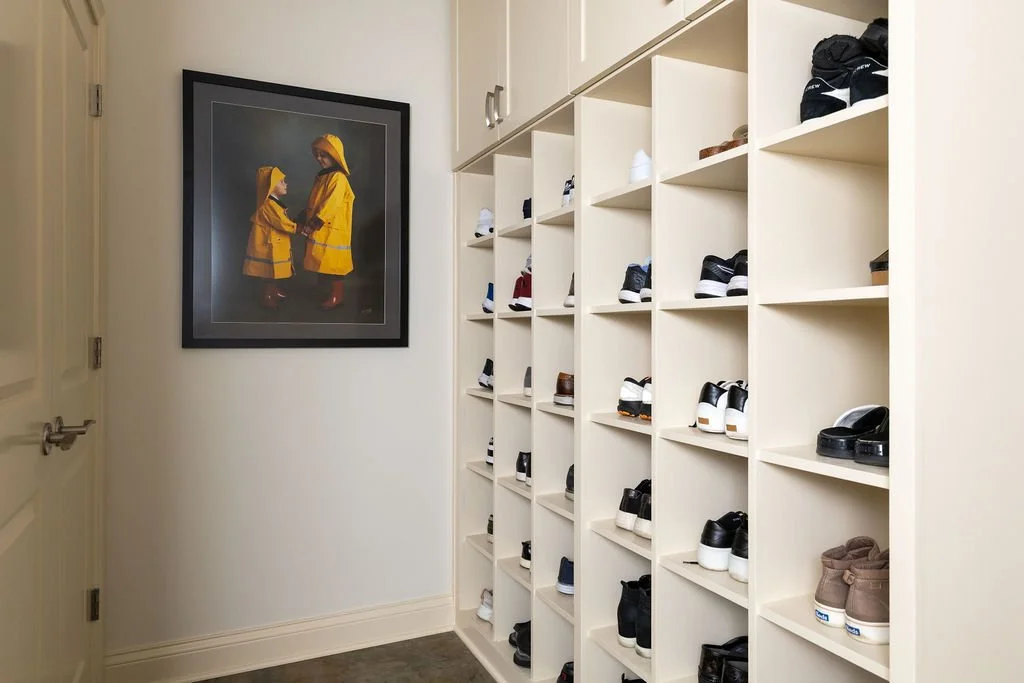
Entry areas and mudrooms are essential in Indiana homes. Coats, shoes, backpacks, and bags need accessible storage right at the door. A simple guideline: provide storage for at least two to three pairs of shoes and one coat per household member near the entry.
Kids' rooms need flexible systems. Toys, books, and clothing change constantly as children grow. Adjustable shelving and modular storage solutions that adapt over time are almost always the smarter investment.
Basements often carry the weight of long-term storage — seasonal items, rarely used equipment, household supplies. But when storage becomes disorganized, basements get crowded and hard to navigate. A basement remodel is a real opportunity to combine organized storage with actual living space, rather than sacrificing one for the other.
The Hidden Storage That's Already in Your Home
One of the most satisfying parts of Wendy's work is walking through a home and finding storage opportunities that owners have been walking past for years.
"The square footage is almost always there. It just hasn't been asked to do anything yet."
She worked with a client in an older Carmel home with a beautiful staircase. Beneath those stairs was a fully drywalled space — completely sealed off since the home was built. "When we opened it up, there were over 80 cubic feet of completely accessible space. We designed a run of custom built-in drawers across the lower portion, with a concealed door that opened into a larger storage alcove toward the back — perfect for luggage and oversized seasonal items. From the outside, it was completely seamless with the millwork in the adjacent hallway. No one looking at it would know it was storage."
Other hidden opportunities worth exploring in almost any home include the space between wall studs for shallow bathroom or hallway storage, toe-kick drawers beneath kitchen cabinets for baking sheets and flat items, ceiling-mounted racks in garages for seasonal items, and multi-functional furniture like storage ottomans, benches with hidden compartments, and beds with built-in drawers.
These strategies often become part of a larger renovation — particularly a whole home remodel where multiple rooms are redesigned together and storage can be integrated throughout rather than addressed room by room.
Clear the Clutter Before You Plan the Storage
Before designing new storage, take an honest look at what actually needs a home.
Most people accumulate things over time without stopping to ask whether those items still serve a purpose. When storage systems are built around things you don't really need, they become inefficient almost immediately. A few honest questions can help: How often do I actually use this? Does it need to be easy to reach? Could it be stored somewhere else — or donated?
Digital alternatives can also reduce physical storage needs more than people realize. Paper documents, photos, and files can often be stored electronically, freeing up meaningful space.
Think About How Your Storage Needs Will Change
Storage planning should look ahead, not just at today.
Life changes. Kids grow up. Hobbies shift. Empty nesters end up with storage systems that were built entirely around school-age children. Wendy has walked into many homes where the storage was designed for a version of the family that no longer existed.
Flexible systems — adjustable shelving, modular cabinets, multipurpose rooms — allow homes to adapt as life changes. Planning for that flexibility also adds resale value, since future buyers will have different needs than you do today.
Should You Add Space or Reorganize What You Have?
This is one of the most common questions homeowners ask — and the answer is usually to reorganize first.
Custom shelving, improved cabinetry, and smarter layout planning can dramatically increase usable storage capacity in spaces that already exist. In many cases, that's all it takes.
But when storage problems are affecting multiple areas throughout the home, a larger renovation may be the right answer. A whole home remodel allows the team to rethink how storage is distributed across the entire house — not just fix it room by room.
Basements offer another valuable path forward, adding both storage and living space without changing the home's footprint.
Why Good Storage Changes How Your Home Feels
This is where the wellness conversation and the design conversation become the same conversation.
There's real research behind what most people already know intuitively: visual clutter creates mental load. When your environment is disorganized, your brain is constantly doing background processing — registering the pile on the counter, the overflowing closet, the things that don't have a home. That processing is low-level but constant, and over time, it's exhausting.
Wendy hears this from clients after every remodel. "They say things like 'I feel lighter' or 'I can actually breathe in here.' They're not being poetic — they're describing a genuine physiological shift that happens when a space stops working against you and starts working for you."
The goal isn't a home that looks like a magazine. It's a home where everything has a place, the systems are built for the people actually using them, and you're not spending mental energy managing your environment every time you walk through a room.
"When storage is designed well, you stop thinking about it. That's the point. The home holds itself together so you don't have to."
Storage That's Built Around Your Life
Ultimately, good storage planning isn't about finding places to put things. It's about creating systems that support the way you actually live.
The first question Wendy asks before any storage design begins isn't "what do you need to store?" It's simpler and more revealing than that: "Walk me through your morning from the time your alarm goes off to the time you leave the house."
That question surfaces the real friction points — the counter that gets buried every morning, the closet that requires excavation to find a work bag, the shoes that end up in the hallway because there's nowhere logical for them to go.
"Most storage problems aren't storage problems — they're flow problems. Stuff accumulates in the wrong places because the right places don't exist, or because the right places are in the wrong location relative to how the family actually moves through the home."
When storage is thoughtfully integrated into the design of a home, daily routines become easier. Kitchens stay clear. Entry areas stay tidy. Belongings have a natural place to return to. And the home — finally — feels like it's working with you instead of against you.
If you're starting to feel like your home simply doesn't have enough storage, the real solution may be better planning rather than just more cabinets. The team at Everything Home Designs works with homeowners throughout Carmel and Central Indiana to design storage that fits how your household actually lives. Schedule a consultation and let's figure out what your home is actually missing — and how to fix it for good.